- Metal purity: It represents the content of the dominant precious element-example Gold or Platinum (Pt). This is ascertained by the stamp on the jewel. Metal content is represented either as fraction of 24K (100%); so 18K is 75%, 14K is 58.5% or a fraction from 1000, so 750 is 75%, 950 is 95% and so on.
- Gram weight: It represents the gross weight of the jewelry in grams as per metric system of measurement. The gram weight is mentioned up to the 2nd This includes the stones & metal weights
- Carat weight: It represents the weight of the gemstone in carats; 1 carat is equivalent to 0.20 grams. We mention the weight in 2nd decimal (Ex: 1.799 = 1.80, 1.798= 1.79). Importantly, IDL verifies the carat weights individually for various types and cuts of stones. The total carat weight is a consolidation of individual types of stones
- Shape & Cut: Describes the geometrical form of the gemstone and the Cut style of the facets.
- Common shapes are round, oval, pear, cushion, marquise, rectangular etc.
- Cut styles can be step or brilliant or combinations of these and cabochon. In specific cases a “Cut Quality Grade” will be included in the report.
For Diamonds- Single stones reports or Set in Jewelry
IDL grades diamonds as per CIBJO standards which are the Gemological Institute of America (GIA) scale.
- Single stones or jewelry with Solitaires- Always only Single Color & Clarity
- Multi Stones in jewelry-
Single Grades– If minimum 90% are of a single grade, we grade as per the single grade; anything below 90% will be either a split grade (up to minimum 30%) or the lower grade/s.
- Example for clarity- Minimum 90% VVS, 10% VS1, we grade as VVS.
- Example for color- Minimum 90% are F and 10% are G, grade as F.
- Split Grades–
- 2 grades in a report- Minimum 30-40% should of better quality and Maximum 10% of lowest quality
- Example for clarity- Minimum 30% VS, 70% Si- we grade as VS-Si
- Example for color- 30% F, 70% G- grade as F-G
- 3 grades in a report- Minimum 20% should of better clarity.
- Example for clarity- 20% VS, 60% Si, 20% I, grade as VS-Si-I
- Example for color- 20% F, 50% G, 30% H, grade as F-G-H
- 4 or more grades observed- Each clarity should be minimum 20%, grade is split as per actual observation
- Example 20% VVS, 25% VS, 40% is Si, 15% is I, grade as VVS-VS-Si-I
- Example 20% E, 25% F, 25% is G, 30% is H, grade as E-F-G-H
Important Notes
- A center stone has the major relevance over smaller side stones- and it determines the main grade.
- IDL mentions chipped in our comments section in the report. If the chip is very minor, it is considered as an Si clarity or below.
- Synthetic Diamonds or Synthetic Gemstones or treated/enhanced processes are detected and reported clearly on IDL reports.
- Any treatments detected on diamonds like Irradiation, Hight Pressure High Temperature (HPHT)- for color enhancement or laser drilling, fracture filling for clarity enhancements are mentioned in IDL reports.
For Gemstones- Single stones reports or Set in Jewelry
- Species: Represents the mineralogical “family” of the gemstone (corundum, beryl, quartz, zoisite, tourmaline, etc.). All members of the species share the same optical and physical properties.
- Variety: Represents each member of the species based on a difference in color or phenomena. Examples. a red Corundum is a Ruby, a blue Beryl is an Aquamarine, a color change Chrysoberyl is an Alexandrite.
- Transparency: It represents the ability of the gemstone to transmit light. The grade depends on the internal characteristics of the gemstone, presence of inclusions, feathers, fissures or the nature of it as a single crystal or an aggregate.
IDL uses an 8-point scale to describe its Transparency
- Color: It is the visual appearance of the gemstone and is the result of its three components- hue, tone and saturation.
- The Hue is the tinge position on the visible spectrum (from red to violet). Could be a “pure” color or composed of two or more components (Example- pleochroic gemstones, multicolored gemstones).
- The Tone is about how light or dark the tinge is.IDL uses a 5-point scale to define the tone.
- Very Light- Almost colorless, like water
- Light- Soft, pastel tones
- Medium- Rich perfect tones, balance of light and dark
- Dark- Deep color, some details still visible
- Very Dark- Nearly black or indistinguishable color
- The Saturation is the intensity of the Hue. IDL uses a 5-point scale to define the saturation.
- Very Slight- Just a tinge of faint color
- Slight- Slightly Muted Color
- Moderate- Pleasing, Intense Color
- Strong- Brighter, Vivid Color
- Very Strong- Exceptional, Brightest Color
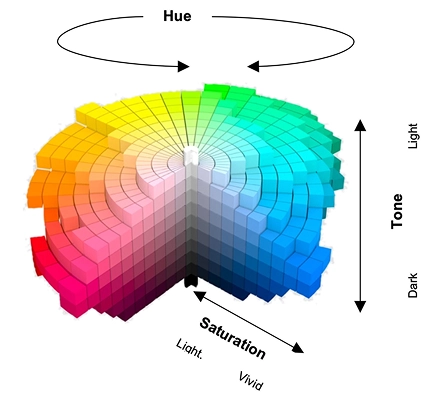
Our Gemologists use a combination of the 3 components- Tone, Saturation & the Hue to define a color.
Example 1– a greenish blue sapphire with an intense saturation along with a dark tone will be ‘Deep Greenish Blue’.
Example 2– a pink spinel with a Slight Saturation and Light Tone will be described as ‘Light Pink’ color.
- Enhancements & Treatments: Indicate if the gemstone exhibits the presence of an artificial process applied to it by humans. The objective is to improve the color or its transparency or both. Enhancements & Treatments are commonly used in the trade for most gemstones of commercial qualities. Different methods are used for different gemstones.
- Color Treatments–
- H: It means Heated. The stone exhibits indications of Heat treatment (ex. Sapphires, Rubies)
- D: “Ti” The stone has been treated by Heating process and surface Diffusion of foreign chemicals (Titanium), to induce or drastically improve the color intensity (Commonly found in Sapphires).
- T: “Be” diffused. The stone has been treated by Heating process and deep diffusion of foreign chemicals (Beryllium), to induce or drastically improve the color intensity (Commonly found in Orange Sapphires).
- I: The stone has been color treated by irradiation followed by a heating process to modify and stabilize the color (commonly found in. Blue Topaz).
- SC: Surface Coating. The stone exhibits indications of color treatment by the application of a thin layer of coating on the pavilion surface (ex. Pink Topaz).
- Clarity Treatments–
- C: the stone exhibits indications of clarity enhancement with presence of foreign substance (oils or resins) in internal fissures (commonly found in Emeralds). It is graded as Minor, Moderate or Significant evidence.
- Ha or Hb: It means that the stone exhibits indications of Heat treatment with presence (minor (Ha) or major (Hb) of foreign substance in internal fissures due to the heating process (commonly found in Rubies).
- G: Clarity treated. The stone exhibits indications of Heat treatment with significant presence of foreign substance (lead-glass) in internal fractures (commonly found in Rubies).
- Gc: Clarity & Color treated. The stone exhibits indications of Heat treatment with significant presence of foreign substance (Cobalt-doped glass) in internal fractures (commonly found in Sapphires).
- N: It means that the stone does not have any indication of enhancement/treatment. These stones are rare and valued highly.
- Origin: It is possible in some cases to determine the geographic origin of the gemstone mostly for Ruby, Sapphire & Emerald. This is considered as an opinion of the gemologist, after reviewing the gemological and spectrographic characteristics of the stone.